

FIELD NOTES: Hip Hop x Mental Health; Hip Hop's "Powerful" Media; Black Rest; Upcoming Events
The problem with amplifying "powerful" but misaligned Hip Hop media figures

✌️ Peace and love. First off, May is Mental Health Awareness Month. For those new to this newsletter and the Hip Hop Can Save America! ecosystem, I’ve spent years interviewing people working at the intersection of mental health and Hip Hop culture — exploring how culturally grounded approaches can uplift lives in ways traditional systems often have not, particularly for communities of color and other marginalized groups.
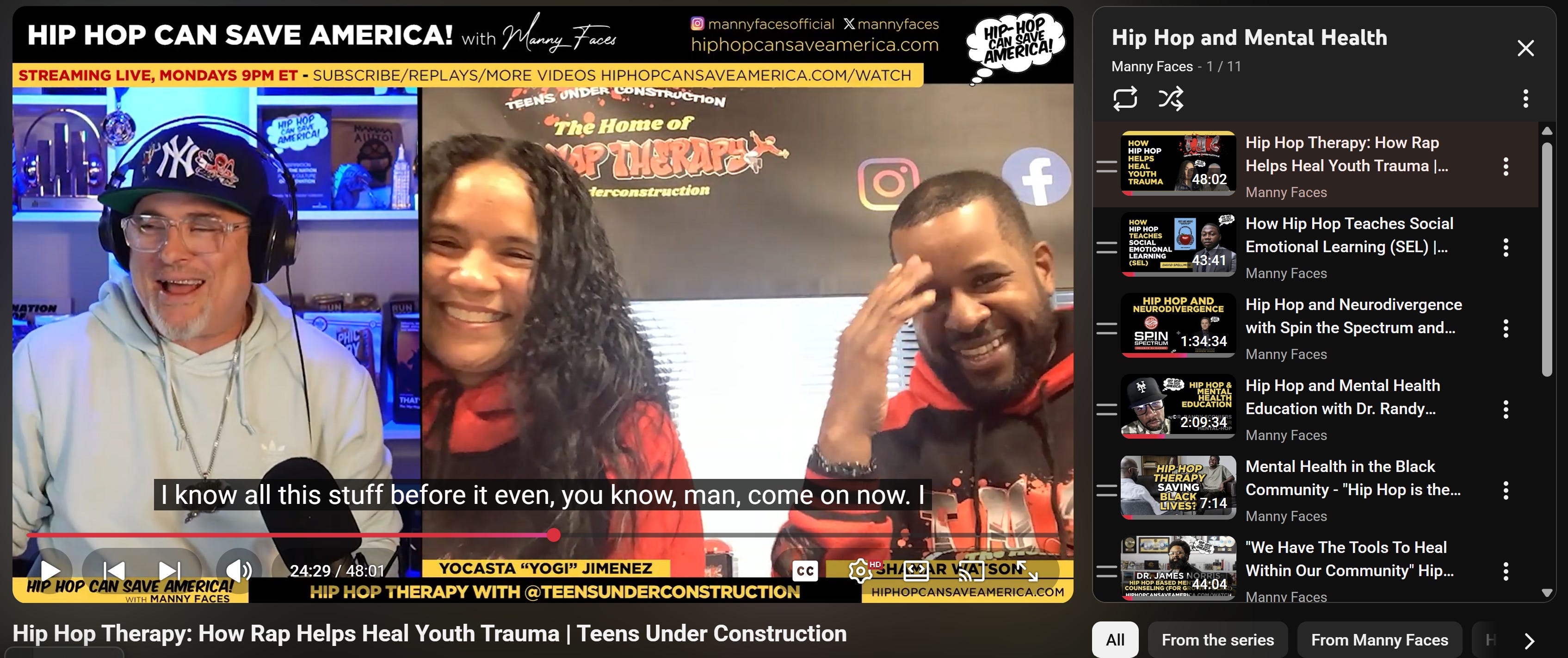
To get a better understanding how powerful this can be, please take some time to explore our Mental Health-focused YouTube playlist and our older episodes from the audio podcast, featuring conversations with mental health professionals, school counselors, authors, advocates, and more.
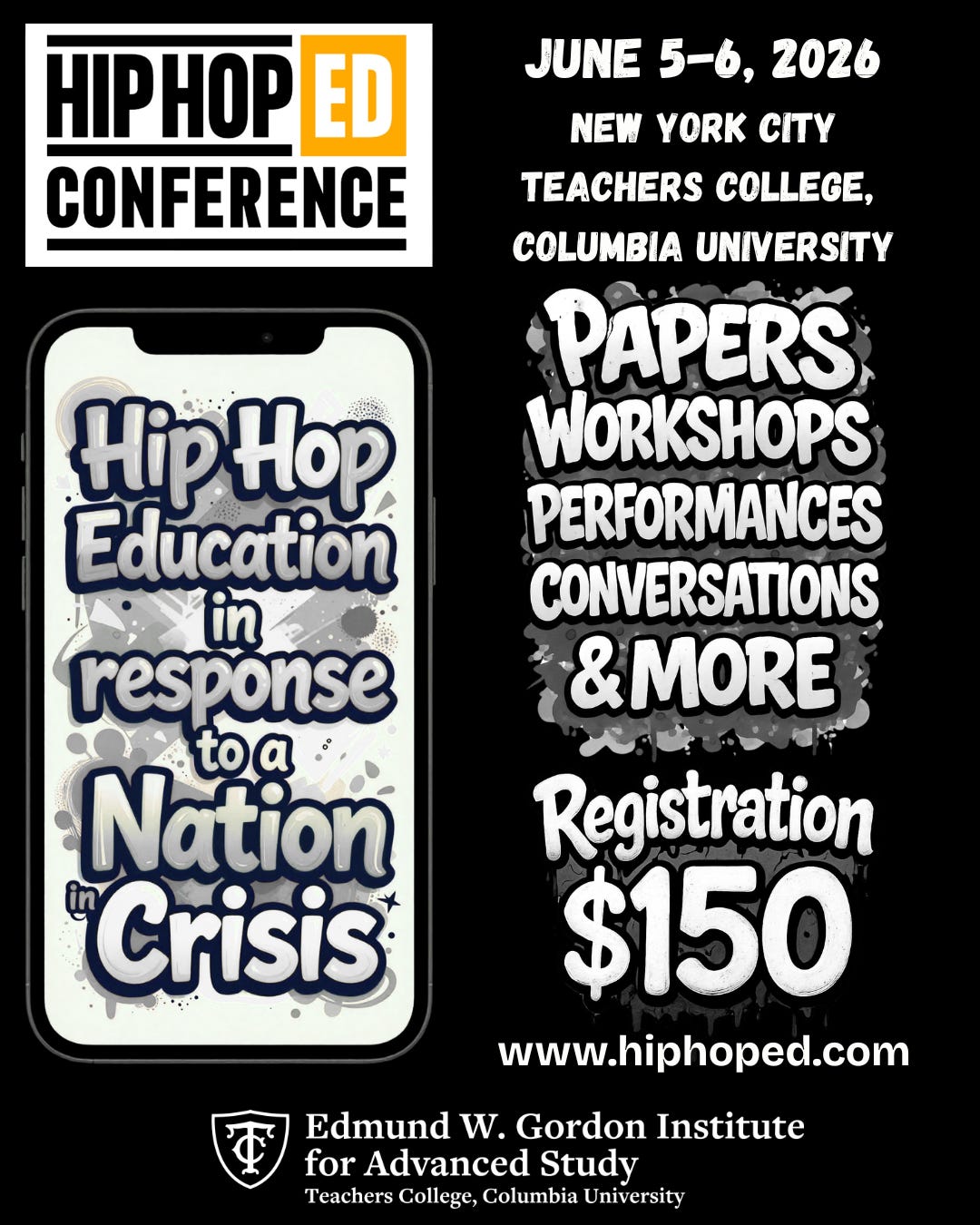
This newsletter drop is brought to you by the 2026 #HipHopEd conference, happening June 5-6 in NYC. This is the premier event in the field of Hip Hop and education, and it is dedicated to advancing innovation, scholarship, and practice. This year’s theme is “Legacy Work: Hip-Hop Education in Response to a Nation in Crisis”
👀 WHAT I’M NOTICING
Recently, a friend pointed to Complex Media’s Hip-Hop Media Power Ranking: The 2026 Edition, with the emphatic assertion, “YOU SHOULD BE ON THIS!”
Oh God no.
I mean, I understand (and appreciate) what they meant. To them (and many others I suppose), my work as a journalist, advocate, speaker, and cultural commentator epitomizes what a “Hip Hop” journalist should be doing. After all, I have a journalism background, and I work really hard to cover the entirety of the culture — including its many “elements” — and I am always amplifying the ways Hip Hop contributes to society in beneficial ways.
In fact, thinking of everything I speak about, how Hip Hop can help improve education disparity, create better mental health outcomes, be a force for social justice, helping uplift and even save lives — especially among the historically underrepresented and marginalized communities from whence Hip Hop came — it could be argued that my brand of Hip Hop media might be the most “powerful” of them all.
The thing is, that’s not what this is. The Complex list isn’t even a “Hip Hop” list. It doesn’t celebrate the work of myself and others who see “Hip Hop” and think “culture.” It’s a rap media list, and even then, narrowly focuses on certain individuals and outlets.
Power here means cultural influence—who can spark and steer viral rap debates.
Ugh. That’s the kind of “cultural influence” worth celebrating? That’s the type of “Hip Hop media power” worth spotlighting? Not only does this do nothing to promote those in Hip Hop media who are actually doing culturally responsible work, but apparently we have forgotten the danger in platforming “powerful” but incredibly harmful figures in the media simply because they might be entertaining or super controversial or have some level of pre-existing fame or, you know, make racist and xenophobic comments after riding down a golden escalator.
Look, these folks on the list definitely have reach and influence. I’m not here to pick the list apart or judge any entrant on their merits. As you may know, I think every ranking list is largely useless. The bigger picture here is that Hip Hop needs a real wake up moment when it comes to who gets to tell the world what “Hip Hop” is and isn’t, and who should be considered “powerful.”
The way I see it, any instance where “Hip Hop” is reduced to only rap music or the ill-defined-and-equally-problematic “rap culture,” dilutes Hip Hop’s enormous, yet consistently underrepresented cultural value. No one on the “Hip Hop media power ranking list” talks much — if at all — about the expansive nature of Hip Hop culture outside of mainstream music, the entertainment business, gossip, drama, or controversial subjects likely to drive viral views and engagement. Similar to mainstream media’s trajectory in recent years, this will always be a part of the broader free market media landscape. Still, for Complex to so casually equate [(Hip Hop = Rap)], and then anoint these individuals and outlets as what Hip Hop media “power” looks like — and for those individuals and outlets to happily play along, knowing they don’t actually represent the culture in its fullest sense, nor its most “powerful” characteristics — sets an extraordinarily troubling tone that threatens the very fabric of the culture that helped make these folks known and, in many cases, wealthy in the first place.
The issue is three-fold. One, a list like this exalts several individuals and outlets who are absolutely harmful to Hip Hop, whose contributions do little more than add to the narrow, derogatory, and stereotypical ways that the music, culture, and associated people are seen by society at large.
Second, it doesn’t even come close to considering that “power” is more than the ability to go viral. It ignores the power in Jay Quan’s work helping document stories about Hip Hop’s pioneers, or how Jerry Barrow, andrejgee, or Rodney Carmichael look at music and culture from important angles while clearly caring, or what I do every day to highlight ways Hip Hop is helping improve and save lives (independently, without institutional backing). Barbershop debates engineered for outrage, corporate shills pushing company lines, and paid provocateurs adding to the noise isn’t the kind of “power” Hip Hop most desperately needs amplified. The power worth elevating is the kind that respects the culture in its entirety, increases collective understanding, provides value beyond mere entertainment, and honors the legacy of the great Hip Hop journalists and media figures who were largely run out of the game by the very tactics that helped create many of the careers on this list.
And third, it’s bugged me for years, for example, that Elliot Wilson (who sits at #32 on this list) self-proclaims himself the G.O.A.T. of “Hip Hop journalism.” Debatable, subjective, clever branding, whatever... But let’s be clear. Elliot Wilson is very much a rap journalist. He has never been a Hip Hop journalist. He knows the difference, but chooses to maintain the title. And I understand why. For so many of us, saying “Hip Hop” when we really just mean “rap music” has become second nature. I am arguing that for many reasons, this framing, this lack of clarity, this looseness and merging and interchanging of terms like “Hip Hop,” “Hip Hop culture,” “rap culture,” “for the culture,” etc. — is part of a pattern of behavior that is ever-increasingly destructive to what Hip Hop actually represents.
So yes, part of this is an argument over semantics. For a culture with so many different modes of expression at the heart of its DNA, and a genre focused so much on language, these distinctions matter. And as we watch the culture get further and further diluted, it’s becoming more and more urgent for the individuals and major media platforms who know the difference to stop muddying the waters and start making these distinctions clear.
And also, let’s maybe consider not patronizing those who continue to profit through controversy, who happily amplify those who are harming the culture and the people associated with it for clicks and advertising dollars. That decision shouldn’t be too complex.
(I’ll have more on this later. For now, let me know your thoughts.)
🤔 WHAT I’M THINKING
🏀🔵 Knicks in 5 with OG, 6 without.
📖 WHAT I’M READING
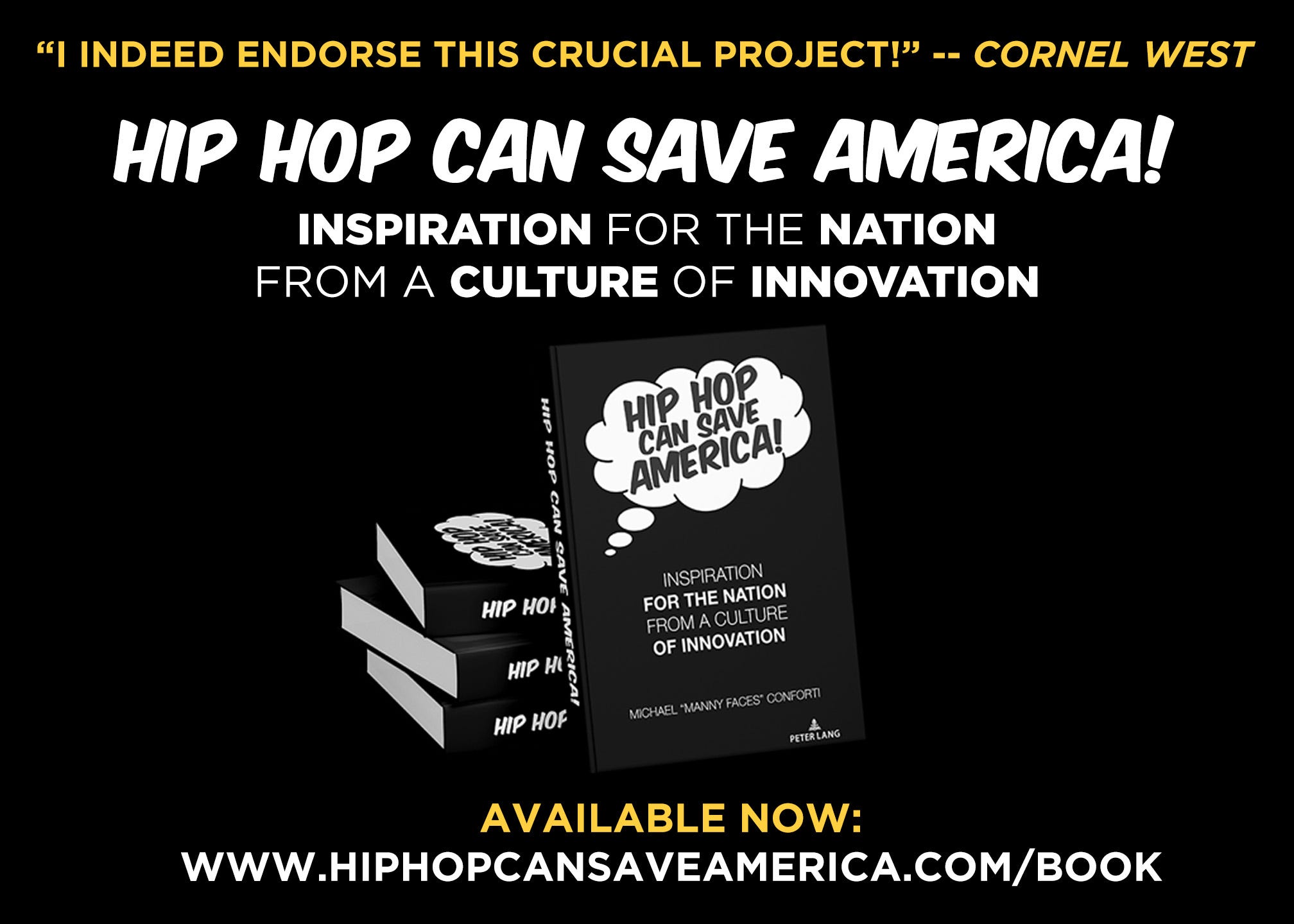
The Cornel West-endorsed, “Hip Hop Can Save America! Inspiration for the Nation from a Culture of Innovation”
🎧 WHAT I’M LISTENING TO
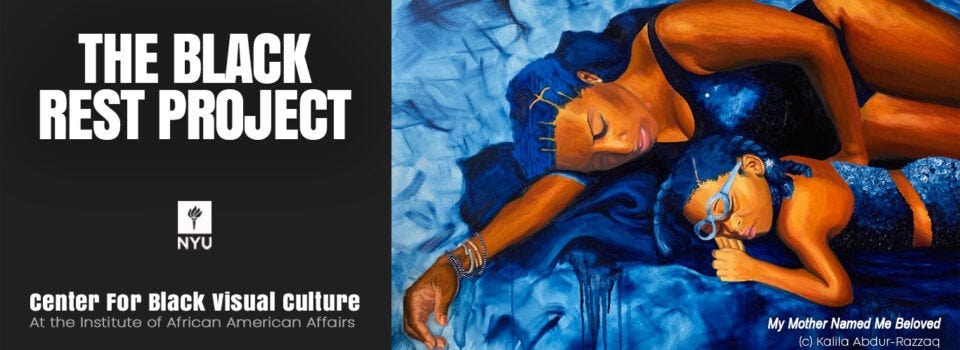
The Black Rest Podcast, hosted by Dejha Carrington and produced by NYU's Center for Black Visual Culture, is a thought-provoking series exploring rest as a radical, restorative act of resistance and joy for Black communities. The podcast features conversations with artists, scholars, and activists, covering topics like ancestral wisdom, healing, and the intersection of creativity and, in one example, water.
I was honored to audio engineer this important series. Special shouts to Jermaine Charles and Dr. Joan Morgan.🙏
Listen on Apple Podcasts. Visit their website here.
📺 WHAT I’M WATCHING
The Boys [Final season]
📽️ My debut short film! (Sort of. 🤪) [INSTAGRAM LINK]
🫶 WHAT I LOVE
Being booked and busy! Thanks to the Black AF Conference at UMass Amherst, Trinity International Hip Hop Festival, the European Hip Hop Studies Conference, Fairfield Ct. School District, Courtyard Brewery in New Orleans, Hippin’ Hops in ATL… Next up, I’ll see you at #HipHopEd in NYC! (see event listings below!)
My talks generally revolve around Hip Hop as a vehicle for countering/changing unjust systems. My workshops/PDs revolve around Hip Hop as a way to innovate areas such as education, health & wellness, politics & social justice, podcasting, and more.
I also spin a helluva old school soul/R&B/Hip Hop party 😁
To get more info and to book me to speak, present, consult, or DJ, visit my page or just reply here to hit me up!
😠 WHAT I LOVE NOT
🪳 Palmetto bugs. 🫣
📰 A POLITICAL STORY YOU NEED TO BE AWARE OF
In a controversial Supreme Court ruling in Louisiana v. Callais, the Court weakened a key part of the Voting Rights Act that has long protected Black voting power and representation. Critics say the decision will make it much harder to challenge congressional maps that dilute Black voters, especially in Southern states. Civil rights advocates warn the ruling could lead to fewer majority-Black districts and a major decline in Black representation in Congress, calling it one of the biggest blows to voting rights in decades.
Some commentary:

📅 HIP HOP INTERDISCIPLINARY EVENT CALENDAR
If you have an event that should be listed here, let me know. Please don’t expect me (or anyone) to know about it just because you posted on social media. You’d be surprised how many people tell me they only knew about one of these events because of me. Help me help y’all!
May 13, 2026: Virginia Museum of History and Culture
Asian Americans in Hip-Hop: From Immigration to Influence
May 15, 2026: Atlanta, Ga
May 15, 2026: Atlanta, Ga
WeOnFyre Cypher the OFFICIAL celebration before the RedBull Dance Your Style Atlanta Qualifiers
May 16, 2026: Atlanta, Ga
{also May 23 in Philadelphia, June 20 in Salt Lake City, July 11 in Houston, }
Red Bull Dance Your Style City Qualifier
May 16, 2026: Boondock Coffee Roasters, Los Angeles
The Assembly: A night of local music, vendors, and more as we spotlight talented artists from UCLA. A collaboration between Hip Hop Heads and Hip Hop Congress.
May 17, 2026: Virtual
MIC CHECK: Discussion with PinqyRing on navigating HipHop while building Heaven on Earth
May 24, 2026: Atlanta, Ga
May 26, 2026: Brooklyn, NY
Trivmatic Hip Hop Trivia Night at BierWax
May 31, 2026: Seattle
Red Bull BC One Cypher, Seattle
June 5, 2026, Detroit
Red Bull BC One Studio Takeover Detroit
* Jun 5-6, 2026: Teachers College, NYC
* June 5, 2026: Aloft Harlem, NYC
🎉 Official HipHopEd Day One Afterparty featuring Manny Faces (DJ), Silent Knight (host/performer) and other special guests and artistic friends! NO COVER. Check my calendar for info.
June 6, 2026: The Ohio State University
HipHop Literacies Conference
July 8-12, 2026: NYC
August 22, 2026: San Diego, Ca
Red Bull BC One Cypher USA National Final
August 28, 2026: Brooklyn, NY
Common and Special Guests To Honor the Social Justice Legacy of Harry Belafonte
August 29, 2026: Columbus, Ohio
September 18-20: Tampa, Fl
Red Bull Dance Your Style National Final USA
November 13-15, 2026: Howard University
4th Annual Hip Hop Studies Conference (Recap of 2025 conference)
Submissions due May 1. Early registration is open.
Or for a one-time donation, CashApp: $mannyfacesmedia
Thank you for your support.
You are right for criticizing the media shading and misrepresentation of the (thoroughbred parts of the?) Hip-Hop culture in favor of mostly Rap-related personas and artifacts presented under the "Hip-Hop" label. And the thing itself, as well as the criticisms of it feel like a commonplace for decades now.
On the other hand, there's not much talk about the benefits Hip-Hop culture reaped from the inclusion of Rap tradition (which is older than Hip-Hop). There is also not enough support on either side for the historical/theoretical approaches which are actively trying to clear up the conceptual mess which is causing the misidentifications, misrepresentations, and virtually most of the problems concerning the relation of Hip-Hop and Rap.
I feel that all of us would benefit from a knowledgeable effort which will give credit where credit is due, and I feel that such an effort is long overdue as well.
One more thing - have you noticed the tendency in the last 15-20 years of a vague talk about "the culture" where that label is used ambigously to refer to "African American culture", "Hip-Hop culture", "Street culture"...?